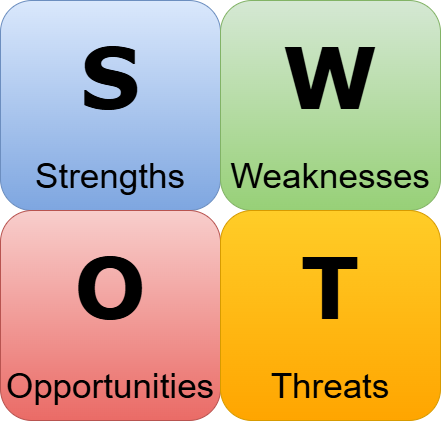
It is imperative that all organizations thoroughly understand the strengths and weaknesses of their environment before attempting to implement significant organizational changes. Conducting a SWOT Analysis is a formal method of identifying and documenting an organization's competitive position to support the development of strategic plans. SWOT stands for Strengths, Weaknesses, Opportunities, and Threats. Senior management gathers data from diverse sources across the organization and analyzes it to create a concise list of findings that fall within one of these four categories.
Once the data has been thoroughly analyzed, it is presented in a SWOT Table, a square divided into four quadrants, each dedicated to one of the categories of the analysis. The SWOT Table presents the organization's key Strengths, Weaknesses, Opportunities, and Threats, which are then used to guide the strategic direction of future business improvements.
Based on this overview, it is easy to see how a SWOT Analysis can be highly beneficial when developing an organization's information security program.
Using the context of an information security program, organizations can follow the steps below to conduct a SWOT Analysis:
1. Determine the Objective:
The SWOT Analysis should be built around the overall objective of the strategic initiative the organization intends to pursue. In this case, the objective is to assess the organization's security posture and determine priorities for implementing an information security program.
2. Gather Data:
Collecting diverse and comprehensive data is critical to conducting a successful SWOT Analysis. During Stage 1 of the CyberLadder Framework, key insights regarding the organization's cybersecurity posture were gathered, and this information can be incorporated into the SWOT Analysis. The analysis should include data regarding both internal and external factors affecting the organization.
The security posture of tangible and intangible assets, financial constraints related to cybersecurity improvements, and the cybersecurity knowledge of personnel are all important considerations. Threat intelligence feeds, vulnerability scan results, reconnaissance activities, and threat hunting operations are valuable sources of information for the analysis.
From a human resources perspective, organizations should engage personnel at all levels to assess the cybersecurity posture of the workforce. Security awareness training results, questionnaires, staff meetings focused on cybersecurity, and employee activity monitoring can all provide valuable insights into organizational security culture and behavior.
3. Compile Ideas and Questions:
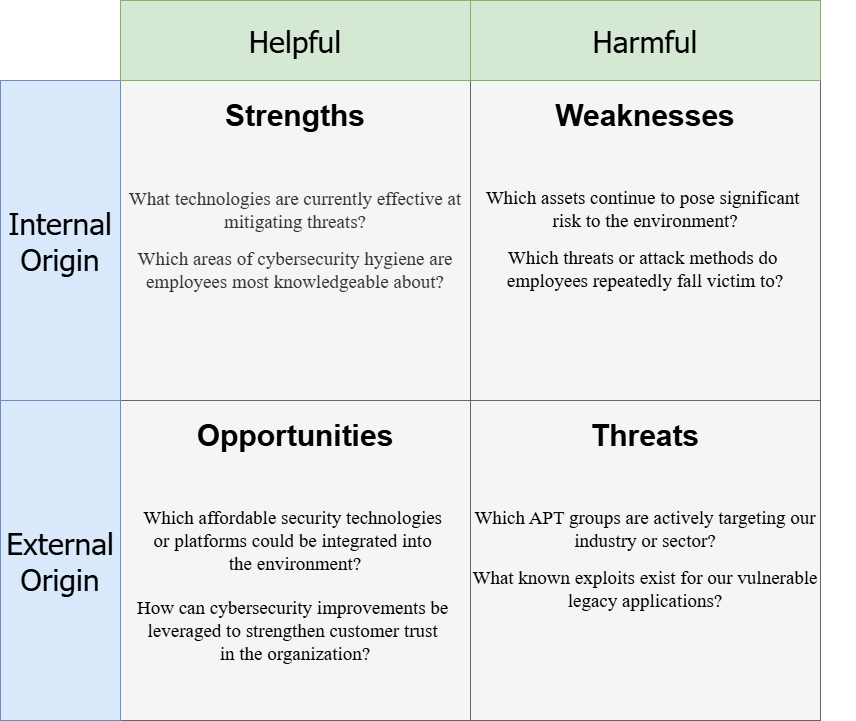
Using the SWOT Table format, senior management can document the major concerns they seek to address through the implementation of an information security program. Questions and concerns should address both internal and external factors affecting the organization.
Each question can be categorized under one of the four SWOT elements: Strength, Weakness, Opportunity, or Threat. In most cases, internal factors are addressed under the Strengths and Weaknesses categories, while external factors are addressed under Opportunities and Threats.
• (Strength) What technologies are currently effective at mitigating threats?
• (Strength) Which areas of cybersecurity hygiene are employees most knowledgeable about?
• (Weakness) Which assets continue to pose significant risk to the environment?
• (Weakness) Which threats or attack methods do employees repeatedly fall victim to?
• (Opportunity) Which affordable security technologies or platforms could be integrated into the environment?
• (Opportunity) How can cybersecurity improvements be leveraged to strengthen customer trust in the organization?
• (Threat) Which APT groups are actively targeting our industry or sector?
• (Threat) What known exploits exist for our vulnerable legacy applications?
4. Analyze Data and Refine Findings:
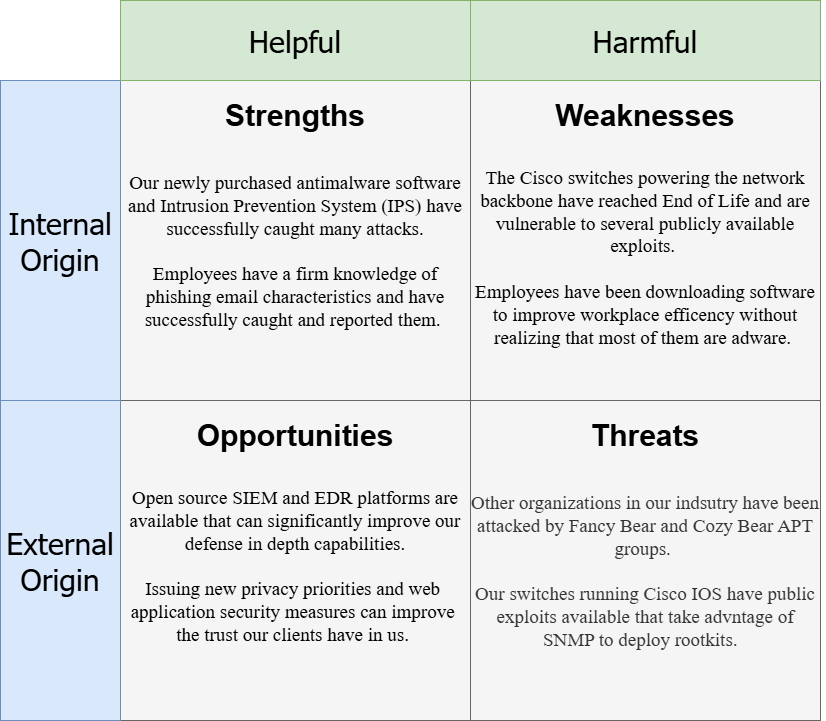
Once the key questions and concerns have been compiled, the previously gathered organizational data can be analyzed to answer them. Both senior management and cybersecurity subject matter experts (SMEs) should be involved in this phase, as an effective SWOT Analysis requires thorough examination of all available information.
Using the SWOT Table template, the questions developed in the previous step can be answered and formalized into a final presentation of findings.
5. Prioritize Findings and Develop Strategy:
Once the final SWOT Analysis has been completed, the organization can use the findings to establish priorities for its information security program. Gaps in employee awareness and security education, vulnerable assets, emerging threats, and opportunities to implement new security technologies are all valuable insights that can help shape the organization's cybersecurity strategy moving forward.
The SWOT Analysis is a classic organizational planning tool that simplifies the complexities of a business environment into actionable insights and priorities. When combined with other security documentation produced during this stage, such as risk assessments and business impact analyses, the SWOT Analysis helps senior management and information security personnel gain a high-level strategic understanding of the organization and identify the key strengths, weaknesses, opportunities, and threats that should be addressed through security planning.