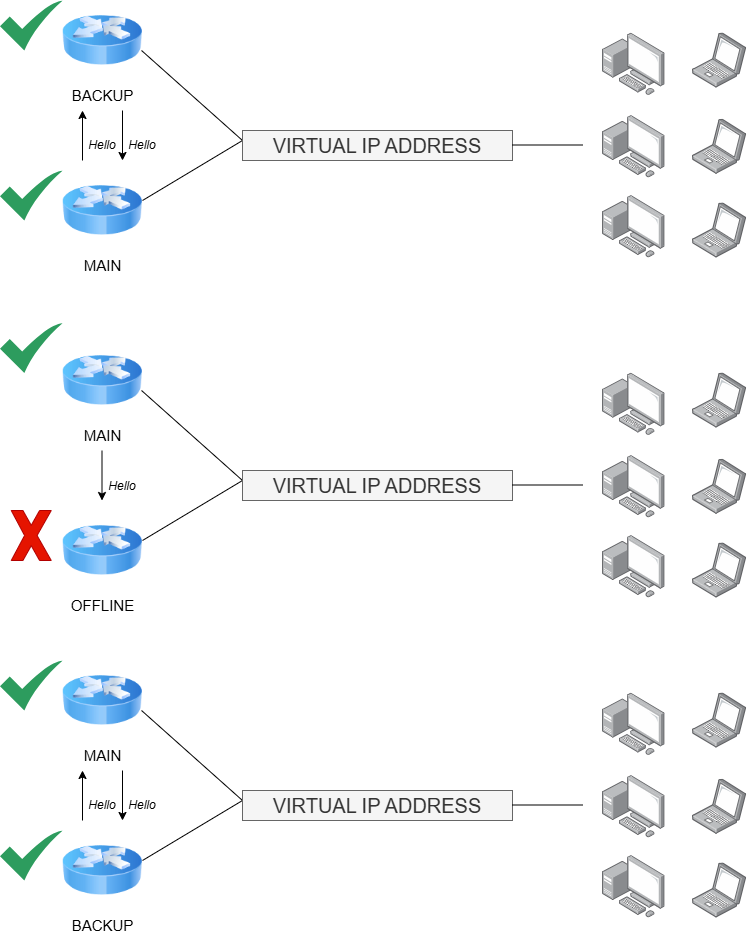
If constant uptime is required, the First Hot Redundancy Protocol (FHRP) could be used to provide default gateway redundancy.
Control Type: Technical
Control Function: Preventive
Description: Some organizations require 24/7, 365 connectivity to the Internet to effectively provide their services. If the default gateway router goes offline even for a little bit, major losses can occur. The First Hop Redundancy Protocol (FHRP) helps mitigate this risk by automatically failing over to a secondary router if the main router goes down. There can be two or more routers in a FHRP setup.
The two routers share a single Virtual IP address that is used as the default gateway by network hosts. In the eyes of the hosts, there is only one default gateway router even though two are sharing the same IP. The two routers send Hello messages to each other to assess whether the other is still online.
If the main router goes offline, the backup router will notice after not receiving Hello messages. In this case, the backup router will take over as the main router, usually within seconds. If the original router comes back online, it takes on the role as the backup router while the original backup router switches to being the main router. This means they are “non-preemptive”. However, settings can be configured to make the main router “preempt” and take its role back.
Cisco networking has a proprietary implementation of this protocol called Hot Standby Router Protocol (HSRP). There is also an open version of the protocol called Virtual Router Redundancy Protocol (VRRP).